
CLIMA co-organized the 2025 Sino–Danish Colloquium on Global Climate Governance and Multilateralism
From 25–30 November 2025, the Centre for Climate Change Law and Governance (CLIMA) at the University of Copenhagen led an interdisciplinary delegation of scholars in law, anthropology and climate science from Denmark, US, New Zealand, and Iceland to China for the 2025 Sino–Danish Colloquium on Global Climate Governance and Multilateralism in Wuhan as well as the welcome event in Beijing hosted by ICDK and the Danish Embassy.
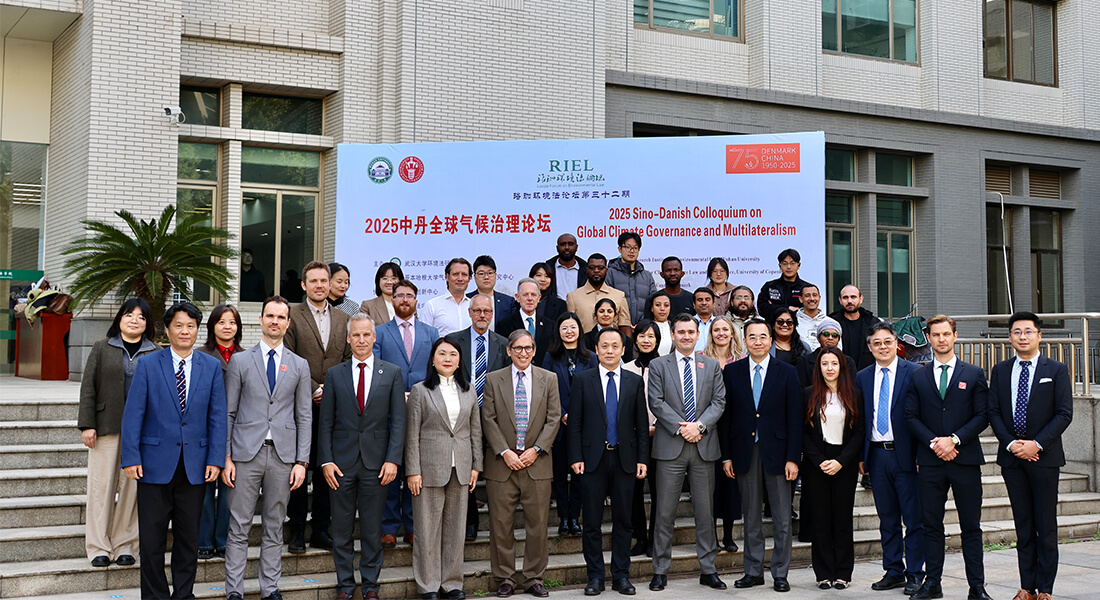
Jointly organized with the Research Institute of Environmental Law (RIEL) at Wuhan University, and supported by the Embassy of the Kingdom of Denmark in Beijing and Innovation Centre Denmark (ICDK), the series of events marked the 75th anniversary of Denmark–China diplomatic relations, the 50th anniversary of Europe–China diplomatic relations and Denmark’s EU Presidency.
2025 Sino–Danish Colloquium in Wuhan: Multilateralism in focus
On 27–28 November, the colloquium was held at Wuhan University’s School of Law. The opening ceremony featured welcome remarks by Prof. Wei Lu, Vice President of Wuhan University, H.E. Ambassador Mr. Anders Siegumfeldt, Deputy Head of Mission of the Embassy of Denmark in Beijing, Mr. Anders Sloth, Executive Director of ICDK Shanghai, Prof. Tianbao Qin, Director of RIEL and Dean of the School of Law of Wuhan University, and Assoc. Prof. Beatriz Martinez Romera, Head of CLIMA.
H.E. Ambassador Mr. Anders Siegumfeldt underlined the special symbolic significance of the forum in a year that celebrates key milestones in Denmark–China and China–EU relations. He stressed that, against a backdrop of rising geopolitical tensions and a deepening climate crisis, defending multilateral cooperation is more important than ever, and highlighted the complementary strengths of Denmark and China in advancing ambitious climate action and the green transition.
Mr. Anders Sloth emphasized that climate change is a global challenge without borders which no country can tackle alone. He argued that effective climate governance must be grounded in science and trust, anchored in multilateral institutions, and supported by close collaboration between governments, universities and businesses. Sino–European cooperation, he noted, is essential for driving green innovation and a just transition.
On behalf the organizers and CLIMA, Beatriz Martinez Romera thanked the hosts and partners and pointed out that global climate governance is moving from a phase of goal-setting to one focused on implementation and interpretation. She stressed CLIMA’s commitment to building bridges that transcend geopolitical divisions by bringing together legal scholars, social scientists and climate scientists to work on shared climate challenges.
Colloquium highlights: Law, science and stakeholder engagement in climate governance
Over two days, keynote and thematic sessions explored the role of international, transnational and domestic law in climate governance, together with the interdisciplinary contribution of climate science and stakeholder engagement.
The first keynote session, chaired by Prof. Tianbao Qin, focused on the recent International Court of Justice (ICJ) Advisory Opinions on Climate Change. Keynote presentations by H.E. Mr. Xinmin Ma (UN International Law Commission) and Prof. Daniel Bodansky (Arizona State University) examined the growing role of international courts and advisory opinions, particularly the recent advisory proceedings before the ICJ, in clarifying states’ climate obligations.
In a second keynote session, chaired by Dr. Meng Zhang (EU Marie Skłodowska-Curie Fellow, CLIMA), turned to climate litigation and climate science. Justice Ms. Qian Sun (Supreme People’s Court of China) discussed how core principles of international environmental law are being interpreted and applied in Chinese climate-related cases. Prof. Jens Hesselbjerg Christensen (Niels Bohr Institute, University of Copenhagen) reflected on how IPCC assessment processes provide rigorous, policy-relevant – but policy-neutral – evidence that underpins global climate negotiations and agreements.
The day concluded with a roundtable on “Reflections on COP 30 and Global Climate Governance”, moderated by Assoc. Prof. Beatriz Martinez Romera. Panellists, including Prof. Bodansky, Prof. Christensen, Prof. Qin and Justice Sun, engaged with students and participants on the legal implications of the ICJ opinion, the role of science in negotiations, and emerging trends in climate litigation.
On 28 November, the second day of the colloquium continued with three thematic sessions showcasing contributions from CLIMA researchers and international shcolars.
The first session, “Climate Governance and Transnational Law”, chaired by Prof. Stefan Gruber (Wuhan University), examined how international and transnational legal processes shape climate action. Prof. Trevor Daya-Winterbottom (University of Waikato) analysed the dynamic effects of climate litigation on regulation and corporate accountability. Assoc. Prof. Beatriz Martinez Romera (CLIMA) discussed international law and the decarbonisation of shipping, highlighting the interplay between the International Maritime Organization’s net-zero strategy and the emerging jurisprudence of the ICJ and the International Tribunal for the Law of the Sea. Assoc. Prof. Chuxiao Yu (Wuhan University) compared advisory opinions of ITLOS and the ICJ, while Dr. Meng Zhang (CLIMA) explored EU–China dynamics in governing the trade–climate nexus in an era of “EU strategic autonomy” and instruments such as the EU Carbon Border Adjustment Mechanism.
The second session, “Climate Governance and Domestic Law”, chaired by Prof. Bodansky, turned to national legal frameworks. Prof. Tianbao Qin (Wuhan University) presented recent progress and future directions in China’s climate change legislation and codification efforts. Prof. Carina Risvig Hamer (CLIMA) analysed the potential of green public procurement in the EU and Denmark’s pathway to climate neutrality, while Prof. Jing Liu (Wuhan University) reflected on the varying roles of courts in climate governance and the specific contributions of China’s judiciary as both “executor” and “supplementer” of climate policy.
The third session, “Climate Governance and Stakeholder Engagement”, chaired by Dr. Meng Zhang, highlighted the importance of communities and rights-holders in climate governance. Prof. Romain Chuffart (University of Akureyri and the Arctic Institute) examined how human rights and Indigenous peoples’ rights can be meaningfully integrated into Arctic geoengineering governance. Prof. Li Ji (Wuhan University) presented participatory research on grassroots involvement in water governance in the Poyang Lake region and its implications for climate public engagement, while Assoc. Prof. Simon Westergaard Lex (University of Copenhagen) analysed community cooperation and citizen participation in Denmark’s green energy transition through a justice-based framework.
A final “take-away” discussion moderated by Assoc. Prof. Martinez Romera, joined Mr. Dimitri de Boer (Chief Representative, ClientEarth), Prof. Christensen, Prof. Hamer and Prof. Ji in discussing climate justice, public interest litigation, and the importance of cross-sector partnerships, highlighting the bridging role of universities between law, science, policy and practice.
At the closing ceremony of the Colloquium, Mr. Sune Kåre Sørensen, Climate and Energy Counsellor at the Embassy of Denmark in Beijing, together with the Colloquium organizers CLIMA Head Beatriz Martinez Romera and RIEL Director Tianbao Qin offered concluding reflections.
Counsellor Mr. Sune Kåre Sørensen highlighted the forum’s timing amidst important diplomatic anniversaries and Denmark’s EU Presidency and summarized three key messages emerging from the discussions: multilateralism remains indispensable for addressing the climate crisis; effective global climate governance depends on ambitious national implementation; and universities play a unique bridging role by providing evidence-based input to policy and training future climate leaders. He stressed that climate cooperation between China and Denmark is not only enduring but gaining renewed momentum.
Beijing welcome events and cultural diplomacy
Alongside the colloquium in Wuhan, the programme included the Welcome Event hosted by ICDK in Beijing and the delegation’s participation in the “Danish Christmas Market” cultural event at the Embassy of Denmark in Beijing on 26 November.
During ICDK Welcome Event in Beijing, scholars of the CLIMA international delegation and partners presented ongoing research on environmental law, climate science and climate governance to Danish alumni, researchers, practitioners, and business representatives in China.
In the evening, the delegation joined the “Danish Christmas Market” cultural event at the Danish Embassy in Beijing. The informal setting provided additional opportunities to strengthen relationships between Danish and international partners and to situate further discussions of climate governance within a broader context of cultural diplomacy.
Looking ahead
Looking ahead, CLIMA, RIEL, the Danish Embassy in Beijing and ICDK intend to build on the momentum of this year’s programme through further joint research, academic collaborations and policy engagement on global climate governance, the green transition and sustainable development.
As initiators and main organizers of the colloquium, CLIMA scholars, Beatriz Martinez Romera and Meng Zhang, reflected:
“The next big things will be lots of small things. At a time of growing geopolitical tension, this Sino–Danish colloquium showed that universities can still create spaces for trust-based, interdisciplinary collaboration. By bringing together legal scholars, social scientists and climate scientists from China, Denmark, Europe and beyond, we not only addressed concrete questions of climate law and governance, but also invested in a community that can carry this cooperation forward.”
CLIMA looks forward to deepening this partnership in the coming years and to continuing to contribute legal and governance expertise to cooperative responses to the global climate crisis.
About Innovation Centre Denmark (ICDK)
Innovation Centre Denmark is a collaboration between the Ministry of Foreign Affairs and the Ministry of Higher Education and Science of Denmark. ICDK is located in seven innovation regions, chosen for their relevance for Danish businesses, researchers, and institutions of higher education.
Topics
Contact
List of the CLIMA-led delegation
(Listed in alphabetical order by surname)
- Prof. Daniel Bodansky: Regents’ Professor at the Sandra Day O’Connor College of Law, Arizona State University, US
- Prof. Jens Hesselbjerg Christensen: Professor, Niels Bohr Institute, University of Copenhagen, Denmark; Ex-officer, Joint Scientific Committee – JSC to the World Climate Research Program - WCRP; Author on the contributions to IPCC
- Prof. Romain Chuffart: Nansen Professor in Arctic Studies, University of Akureyri, Iceland; Managing Director of The Arctic Institute – Center for Circumpolar Security Studies
- Prof. Trevor Daya-Winterbottom: Director, Centre for Environmental, Resources, and Energy Law, University of Waikato, New Zealand
- Prof. Carina Risvig Hamer: Centre for Climate Change Law and Governance, University of Copenhagen, Denmark; Expert member of the Danish Complaints Board for Public Procurement
- Assoc. Prof. Simon Westergaard Lex: Deputy Head, Department of Anthropology, Faculty of Social Sciences, University of Copenhagen, Denmark
- Assoc. Prof. Beatriz Martinez Romera: Head, Centre for Climate Change Law and Governance, University of Copenhagen, Denmark; Editor-in-Chief, Climate Law (Brill)
- Dr. Meng Zhang: EU Marie Skłodowska-Curie Fellow, Centre for Climate Change Law and Governance, University of Copenhagen, Denmark