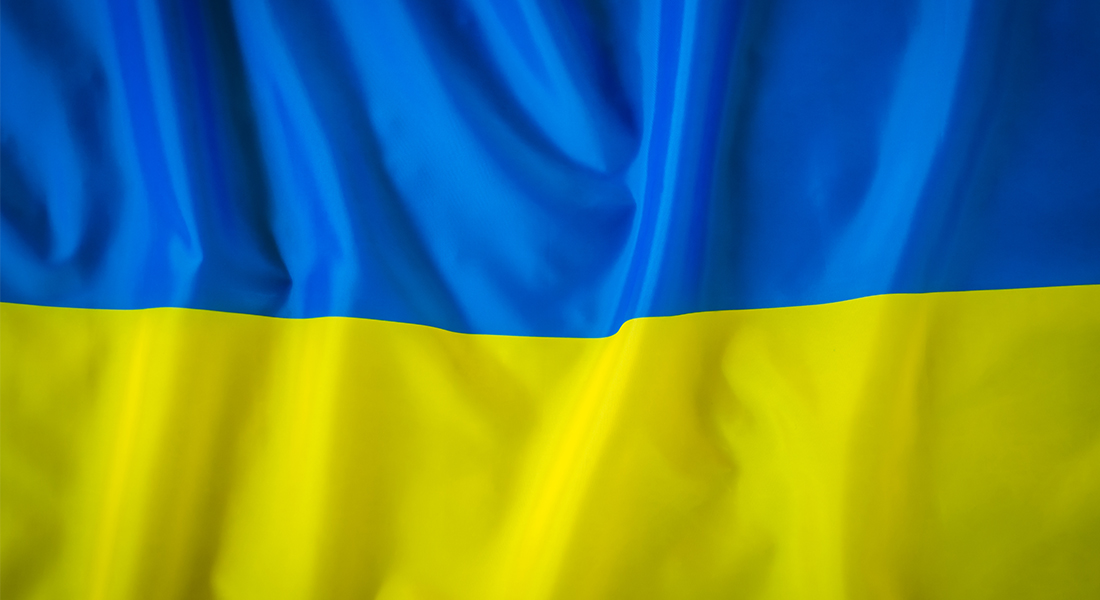
Marking the fourth anniversary of Russia’s full‑scale invasion of Ukraine
On the fourth anniversary of Russia’s invasion of Ukraine, we highlight research conducted by scholars at the Faculty of Law in this field.
The research highlights the need for further studies in areas such as international law, which plays a significant role in Ukraine’s efforts to hold those responsible to account for potential violations of international law and international humanitarian law.
Research focusing on potential violations of international humanitarian law, Ukrainian courts, and the International Criminal Court
Associate Professor Iryna Marchuk has analysed how Ukrainian courts have handled war crimes cases since the beginning of the invasion. In two articles published in the Journal of International Criminal Justice, she examines how Ukrainian judges apply international law, use digital evidence, and how these national cases interact with the International Criminal Court’s investigation concerning Ukraine. Her research informs capacity-building initiatives for Ukrainian prosecutors and judges, and is relevant to other countries, including Denmark, which may exercise universal jurisdiction over international crimes.
Read more in the two articles published in the Journal of International Criminal Justice:
- Rough Waters or Smooth Sailing? Taking Stock of War Crimes Judgments by Ukrainian Courts
- Domestic Accountability Efforts in Response to the Russia-Ukraine War: An Appraisal of the First War Crimes Trials in Ukraine
Iryna Marchuk also conducts research on Ukraine’s cases against Russia before the International Court of Justice (ICJ). She highlights Ukraine’s creative legal strategy, particularly the argument that Russia is acting in breach of the Genocide Convention by invoking allegations of genocide in Donbas as justification for its aggression. In addition to the academic significance of this work, Iryna has advised the Ukrainian government and NGOs in both Ukraine and Denmark on how international law can be used strategically to advance accountability for Russia’s violations.
Read more in the two articles:
- Russia, International Law and the International Court of Justice’ in A Skordas (ed)
- Beyond the False Claim of Genocide: Preliminary Reflections on Ukraine’s Prospects in Its Pursuit of Justice at the International Court of Justice
The research is funded by the Independent Research Fund Denmark (DFF).
Ongoing updates on ‘International law and the war in Ukraine’
A group of researchers regularly publishes expert updates on international law and the war in Ukraine. The idea of providing such updates arose one week after Russia’s full-scale invasion of Ukraine on 24 February 2022. After being inundated with media requests asking questions such as ‘Does international law even matter?’ and ‘Is it lawful to use cluster munitions in urban areas?’, the Faculty of Law’s international law researchers decided to publish short, accessible texts addressing the legal issues that emerged over time. The format quickly proved popular – not only among journalists, but also among practitioners and students – and, after 7 October 2023, the series was expanded to include the war in Israel/Palestine.
A total of 29 updates has been published so far. With the establishment of CERES, the series has been renamed CERES Updates on Law and Security.
Advisory work on aligning Ukrainian legislation with EU standards
When a country wishes to join the EU, one of the first steps is to adapt the country’s legislation so that it becomes compatible with EU law. This does not mean that the country will be admitted – that is a political decision – and in Ukraine’s case, it must be assumed that such a decision is not imminent. However, following Ukraine’s expression of interest in moving closer to the Union, the EU has allocated funding to advise a group of Ukrainian civil servants in their work to adjust the country’s legislation. A consultancy firm has subsequently engaged European researchers with expertise in the relevant areas of law to assist in this process.
Together with other European specialists in the relevant legal fields, several researchers from the Faculty of Law have contributed legal advice on the drafting and formulation of Ukrainian legislation through a series of online meetings with Ukrainian civil servants. It is a substantial and complex task. In the field of Company Law, Professor Jesper Lau Hansen has contributed, and in the field of Procedural Law, Associate Professor Johan Tufte-Kristensen has provided his legal expertise. “It is quite something to collaborate with people who are sitting in the middle of a war zone, but for that very reason it becomes clear just how meaningful this work is,” Jesper Lau Hansen says about the collaboration.
Contact
Katrine Brix Bütow
Kommunikationsrådgiver, Søndre Campus Kommunikation
E-mail: kabb@adm.ku.dk
Telefon: +4593565271