
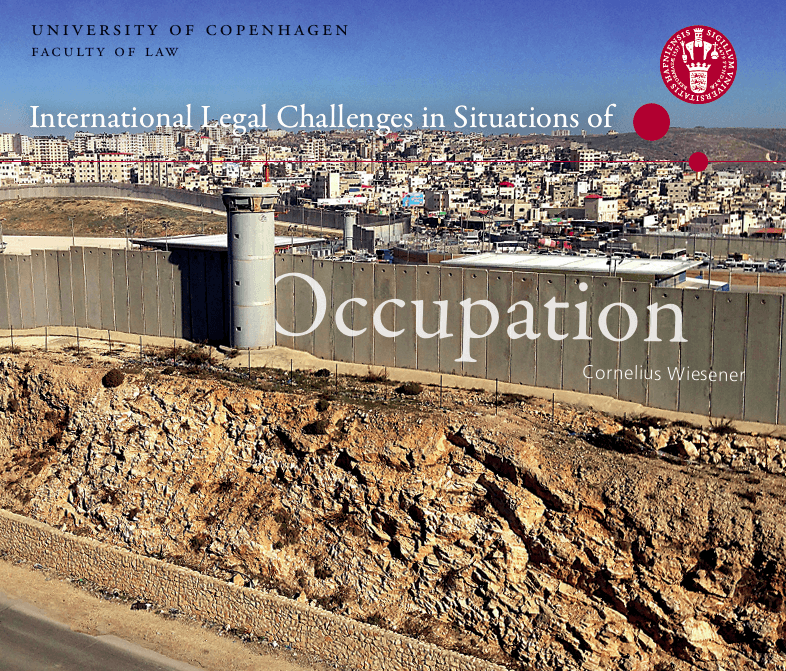
International Legal Challenges in Situations of Occupation
This background paper examines the contemporary legal framework governing occupations and identifies key developments in its interpretation and application. Military occupation remains a recurring feature of contemporary international relations, often persisting for prolonged periods and generating legal questions that the traditional law of occupation was not designed to address. While the foundational rules continue to derive from the Hague Regulations of 1907 and the Fourth Geneva Convention of 1949, courts and scholars have increasingly embraced a functional approach, allowing occupation-related obligations to become applicable along a spectrum rather than through a rigid all-or-nothing model.
The background paper also highlights the growing importance of international human rights law. It serves both a gap-filling function, addressing issues not comprehensively regulated by the law of occupation and international humanitarian law (IHL) more broadly, and an enforcement function, providing affected individuals with avenues for accountability that are largely absent from IHL. Yet the relationship between the two regimes is not without friction. Questions concerning the interaction between IHL and human rights obligations, as well as the appropriate role of courts, continue to generate doctrinal uncertainty.
The same is true of the relationship between the law of occupation and other branches of international law. The ICJ’s advisory opinion on the Palestinian Territory has placed renewed emphasis on self-determination and the prohibition on the acquisition of territory by force. At the same time, it leaves a number of consequential questions unresolved, including the use of force to recover occupied territories, and the relationship between self-determination and resistance to occupation.
Third states, including Denmark and its European partners, must remain attentive to the legal consequences of their interactions with occupying powers, whether in their economic relations or in the context of peace processes. This is particularly relevant in relation to Israel and Palestine, Morocco and Western Sahara, and other protracted occupations.
Overall, the analysis suggests that considerable legal uncertainty continues to surround key issues relating to military occupations. Denmark and other like-minded states should contribute to clarifying these questions through active participation in international judicial proceedings and by fostering the institutional conditions necessary for rigorous scholarly debate.
 Read the report (PDF)